

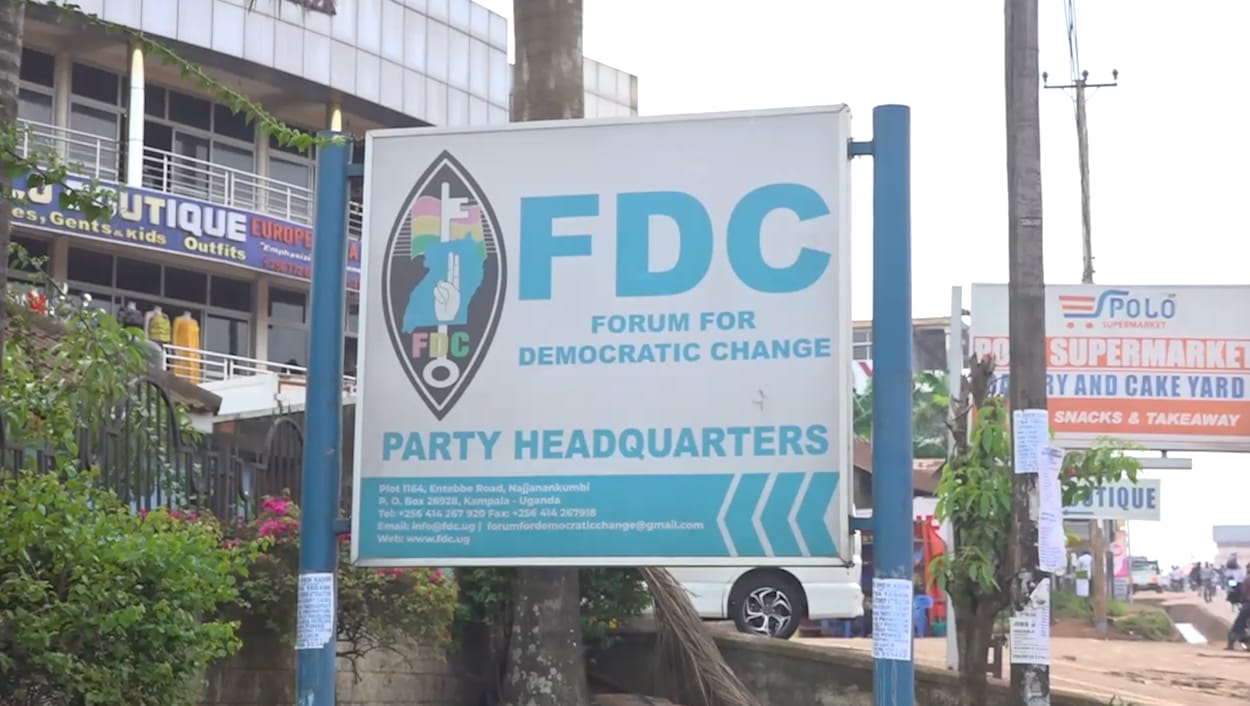
The opposition Forum for Democratic Change (FDC) risks political collapse if its leadership fails to forge strategic alliances with parties that share similar democratic objectives.
Concerns have intensified following the party’s continued erosion of national support, culminating in the 2026 elections where it secured just 1.8% of the total votes cast.
Long-standing strongholds such as Kasese, Buganda, and Teso, where FDC once enjoyed considerable backing, were overtaken by the National Resistance Movement (NRM) and the National Unity Platform (NUP).
Despite these setbacks, party leaders insist that a recovery is possible, with internal consultations underway to determine how FDC can reassert itself on Uganda’s political landscape.
FDC was among the earliest and most organized political formations after Uganda returned to a multiparty system in 2005.
As the country approached the 2006 general elections, the party emerged as one of the most formidable opposition forces, spearheaded by Retired Colonel Dr Kizza Besigye.
His reformist agenda and confrontational stance against the ruling establishment resonated widely, transforming FDC into a nationally recognized opposition platform.
Although FDC did not capture the presidency in 2006, optimism remained high as the party expanded its national footprint and mounted robust campaigns in the 2006, 2011, and 2016 elections.
The party consistently finished second in presidential polls and dominated opposition representation in Parliament, commanding the largest bloc of opposition MPs and serving as the backbone of parliamentary resistance to the ruling party.
However, the party’s political capital has dwindled over time. Public confidence gradually eroded, reflected in the declining vote shares of its presidential candidates.
Dr Besigye secured 26% of the votes in 2011 and 36% in 2016, but support collapsed in 2021 when Patrick Amuriat finished third with 3.3%.
By 2026, Nandala Mafabi also finished third, obtaining only 1.8% of the total vote.
FDC’s parliamentary presence has likewise fallen sharply, from 34 MPs in 2011 to just 10 in 2026.
Party Chairperson Jack Sabiiti acknowledged the seriousness of the situation, noting that investigations into the poor performance are underway and that a national executive meeting will soon be convened to discuss corrective measures.
“We are soon going to call the national executive to discuss this matter. There are many changes that we feel should be done,” Sabiiti told Nile Post.
He attributed the party’s poor showing to alleged electoral malpractice, including vote manipulation, inducement of party agents, and heavy military deployment, which he said constrained opposition mobilization.
Political analysts, however, argue that these explanations overlook deeper structural weaknesses within the party.
Prolonged internal disputes, which culminated in the departures of prominent figures such as Dr Besigye and Gen Mugisha Muntu, significantly fractured FDC’s cohesion and diluted its national appeal.
“Principally all ANT, PFF, and FDC as we now know it should still be one political party. Both in leadership composition and membership. So these splittings have led to the weakening of the party,” said political analyst Ssebastiano Rwengabo.
Rwengabo further warned that the party could disintegrate entirely if it does not build coalitions with other viable opposition forces.
“FDC, as a surviving micro-organism party, does not have the capacity to mobilize Ugandans on its own. They ought to ally and form a joint opposition front,” he said.
The 2026 election cycle highlighted the party’s decline not only in presidential results but also in parliamentary representation, with previously reliable regions such as Kasese, Teso, and Buganda now largely controlled by NRM and NUP.
